← Back home

Service business payments

Verified accounts for US pressure washing businesses taking online payments

A pressure washing job is finished in a few hours, and the customer is standing right there looking at clean concrete. That is the easiest moment you will ever have to get paid — if your payment setup is ready for it.

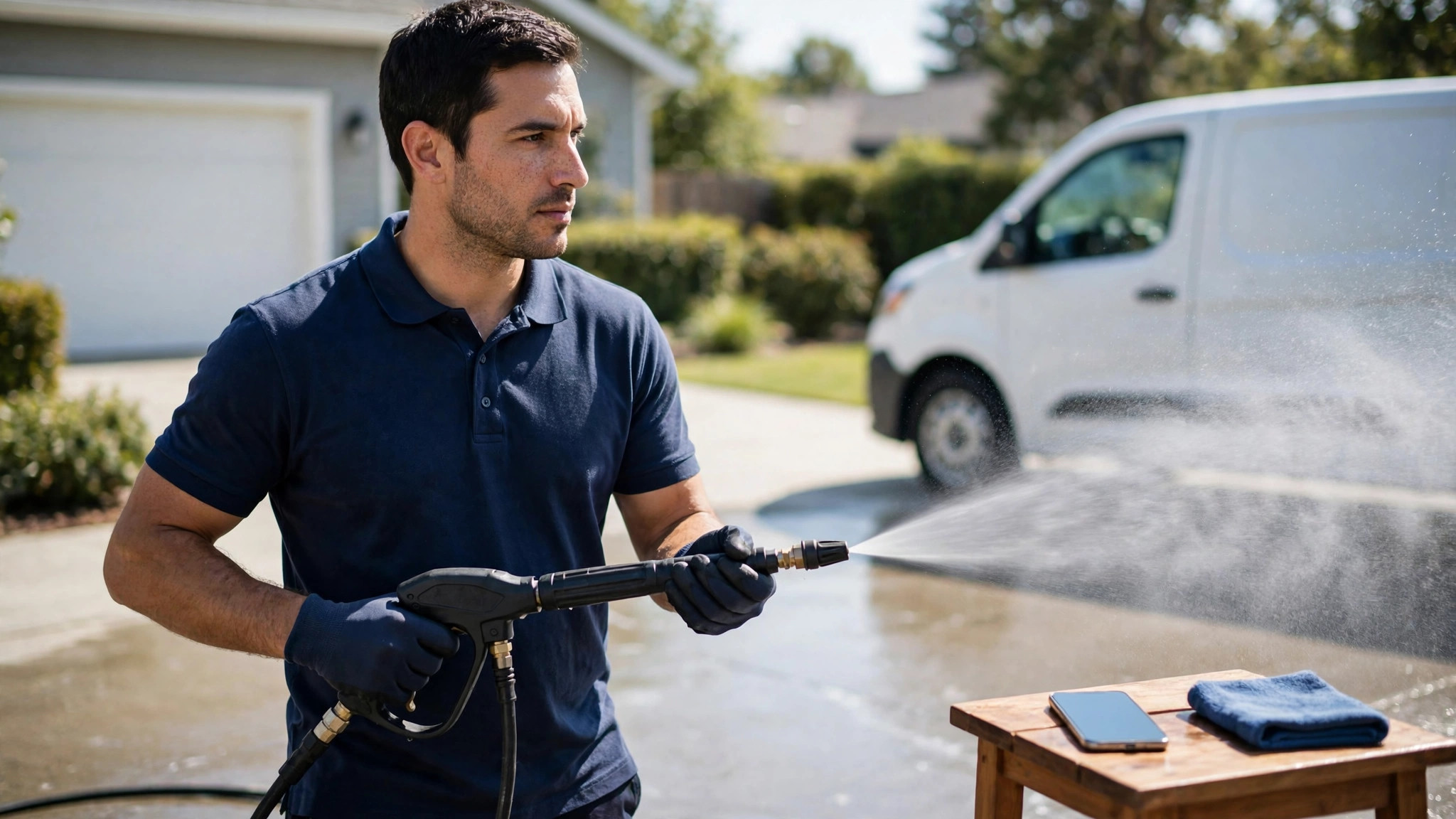
Pressure washing business owner taking a card payment on site

Why payment habits matter more than the washer

Pressure washing is one of those trades where the before-and-after sells itself. The work is fast, the result is visible from the street, and the customer is happy the moment you finish. The gap between a good job and a good business is what happens next: whether the money lands in your account the same day, or whether you spend the next month texting about an invoice.

1. Deposits before the truck rolls

  • Take a deposit on the jobs where your exposure is highest: a full-house soft wash, a roof cleaning, a multi-surface package, or any commercial job that blocks out half a day or more. A deposit in the usual 25 to 50 percent range is easy to justify there, and it gets cash moving before you spend a dollar on chemicals or fuel.
  • For a standard residential job under about $500 — a driveway, a patio, a sidewalk — most pressure washers simply collect on completion. The job takes a few hours and the homeowner is right there. A deposit on a small job can feel like friction; on a big job it feels like professionalism.
  • Attach the deposit request to the quote itself. When you send a professional quote for the house and driveway package, the customer can approve it and pay the deposit in the same step, online, without a phone call. Make the rule simple for the office: no deposit, no date.

2. Collecting on site, before you pack up

  • A pressure washer's best advertising is the clean stripe it leaves on a dirty driveway — and its best payment habit is collecting while the customer is still standing on it. Take payment at the job site, the moment the work is done and the customer is looking at a clean surface.
  • Residential customers almost always have a card on them or a phone in their pocket. With a mobile setup that takes credit cards, Apple Pay and Google Pay right from your crew's phone, you can tap or swipe and be paid before you have rewound the hose. No paper invoice, no waiting for a check, no second trip.
  • Do the final walkthrough first. Walk the customer around the property, point out what was cleaned, and confirm they are satisfied. Then send the invoice or take the card right there. Card processing has a fee, usually in the typical 2.5 to 3.5 percent range — build it into your pricing, but do not let it keep you from getting paid.

3. Invoicing the moment the job is done

  • If you cannot collect on site, the next best thing is to invoice immediately. The gap between finishing the job and sending the invoice is where money goes to die. The longer you wait to send the bill, the longer the customer waits to pay it.
  • Send the invoice from your phone while you are still standing in the driveway. The owner of a one- or two-truck operation is usually the person doing the work, answering the phone, buying the chemicals and handling the books — so invoicing is the task that slides to midnight or to never.
  • Use detailed line items: one line per surface, with the size and the method. An 800-square-foot concrete driveway with a hot-water wash and surface cleaner is a line item, not a mystery number. Put a tappable Pay Now link on every invoice and a clear due date — residential customers should be due on completion or within a week.

4. Commercial and property-management accounts

  • Commercial work runs on different terms, agreed in writing before you start. Property-management companies run on accounting cycles, so Net 15 to Net 30 is normal for them. Larger clients also expect Net 30, and some push for Net 45 or Net 60 — push back if you can, because sixty days is a long time to float materials and labour.
  • For commercial jobs, price by the square foot where it scales. Flat rate works for a driveway, but a parking garage, a shopping-centre facade or a fleet wash needs a rate that grows with the surface. Ask for a card on file or a named contact who authorises payment, so the job does not stall between the site manager and the accounts department.
  • Keep commercial deposits separate from residential ones. A deposit on a roof soft wash or a full shopping-centre job covers chemicals and crew time you cannot get back if the job cancels. Recurring commercial accounts on monthly statements rarely need a deposit — the statement already covers the risk.

5. Recurring routes and seasonal packages

  • Pressure washing is seasonal work, and the businesses that survive winter are the ones that turned one-off jobs into recurring routes. A yearly house wash plus driveway package, a quarterly storefront wash, or a monthly restaurant patio clean gives you income you can plan around instead of a spring rush followed by silence.
  • Bundle surfaces on one visit. A house wash plus driveway shares one trip and one setup, so you can price the package below the two jobs added up and still earn more per hour. The customer gets a better price, you get a bigger ticket, and the route stays full.
  • Keep a card on file for route customers and charge it after each visit, with a receipt sent the same day. Remind route customers before the season starts, not after it ends — a short message in early spring fills the calendar before the phone starts ringing.

6. Keeping every payout on record

  • Most residential jobs land in the $150 to $500 range, with a typical driveway around $100 to $300, a house wash around $200 to $600 and a roof soft wash around $300 to $700. When every job is a different price on a different surface, the only way the books stay honest is a record that ties each payment to its job, its address and its date.
  • Photograph before and after every job, and keep the photos with the invoice. Two photos are the whole defence when a payment is ever questioned — they show what was dirty, what is clean, and that the work was done on the date on the invoice.
  • Reconcile weekly, not monthly. Match each payout in your account to its invoice and mark it paid, and chase anything unpaid while the job is still fresh in the customer's mind. Keep deposits and balances in separate mental buckets: the deposit is a booking commitment, the balance is payment for work done.

When rain washes out the schedule

Rain is part of the trade, and every pressure washer knows the morning a full schedule dissolves into rescheduling calls. What matters is not the weather — it is what your payment setup does when the weather wins. A deposit taken at booking changes the conversation completely: instead of chasing a customer who drifted away, you are moving a paid booking to a new date.

Write the weather rule into the booking confirmation before the first job, not after the first cancellation: a weather cancellation reschedules the job at no extra charge, the deposit carries over to the new date, and the customer is told by text the evening before or a call in the morning. Customers accept a reschedule calmly when the rule was agreed in advance.

Keep the deposit itself untouched until the job is done. If a customer cancels for a reason that is not weather, the deposit terms you wrote at booking decide whether it is refunded, kept, or carried to a future job. Either way, the answer should come from the written terms, not from a negotiation on the phone.

Six mistakes that cost pressure washers money

  • Quoting by text message with no written scope — then arguing about what the price covered.
  • Starting a big roof or commercial job with no deposit and no cancellation terms.
  • Waiting until the weekend to send the invoice for a job finished on Tuesday.
  • Accepting cash and checks only, so every payment needs a second trip or a trip to the bank.
  • Mixing deposits and balances in one bank bucket and losing track of who still owes what.
  • Having no follow-up routine for overdue invoices, so unpaid jobs quietly age into write-offs.

None of these is a washing mistake. Every one is a payments mistake, fixed by the same habit: agree the price and the scope in writing, take a deposit for big jobs, collect payment while the work is fresh, and keep a record that ties every dollar to a job.

A simple setup routine for your first week

  • 1Write your deposit rule down before the next quote: which jobs need one, how much, and what happens if the job cancels or reschedules.
  • 2Put the deposit request on the quote itself, so the customer approves the price and pays the deposit in one step, online.
  • 3Set up card payments on your phone, with tap-to-pay, so the crew can collect before the hose is rewound.
  • 4Build a one-page invoice template with a line per surface, the address, the date and a Pay Now link.
  • 5Photograph before and after every job and file the photos with the invoice the same day.
  • 6Set a simple follow-up routine: a friendly reminder one day past due, a firmer one at seven days, a phone call at fourteen.

You do not need to change everything at once. Start with the next job you book: send the written confirmation, take the deposit, and send the invoice the same day the work is done. Within a month, every payment will arrive in one place, matched to its job.

Deposits book the job

A deposit taken at booking turns a maybe into a commitment — and carries over cleanly when rain reschedules it.

Paid before the hose is rewound

Card payment at the door, or a same-day invoice with photos, collects money when satisfaction is highest.

Photos win disputes

A written scope, a confirmation and two photos are the whole defence when a payment is ever questioned.

This guide is educational information about how service businesses commonly take payments online. It is not legal, tax, or financial advice, and every payment platform sets its own rules and timelines — always check the terms of the platform you use. If your business handles large commercial contracts or operates across state lines, consider asking a licensed accountant or attorney about the setup that fits your situation.

Need a verified account that is ready to take payments?

Every account in our catalog is checked against the same verification standards before it reaches you. Ask us anything before you order.